
Florida Hospital Survey Reveals $2.5 Billion Cost of Delayed Discharges, Strengthening Case for Prior Authorization Reform

Florida Hospital Survey Reveals $2.5 Billion Cost of Delayed Discharges, Strengthening Case for Prior Authorization Reform
A new survey from the Florida Hospital Association (FHA), recently highlighted by Florida Politics, reveals the staggering impact of hospital discharge delays on Florida patients, providers, and health care costs, adding urgency to efforts to reform health plan prior authorization practices.
According to FHA's Days Awaiting Discharge Survey, an estimated 243,000 patients experienced delayed hospital discharges between July 1, 2024, and June 30, 2025, resulting in 781,000 unnecessary hospital days and an estimated $2.5 billion in preventable health care spending.
The findings are particularly significant for the Home Care Association of Florida (HCAF), which has identified prior authorization reform as a policy priority. The FHA survey provides compelling evidence of the consequences of administrative delays across the continuum of care and will be integral to HCAF's advocacy efforts as the association seeks to partner with FHA to advance meaningful legislative policy changes during the 2027 Florida Legislative Session.
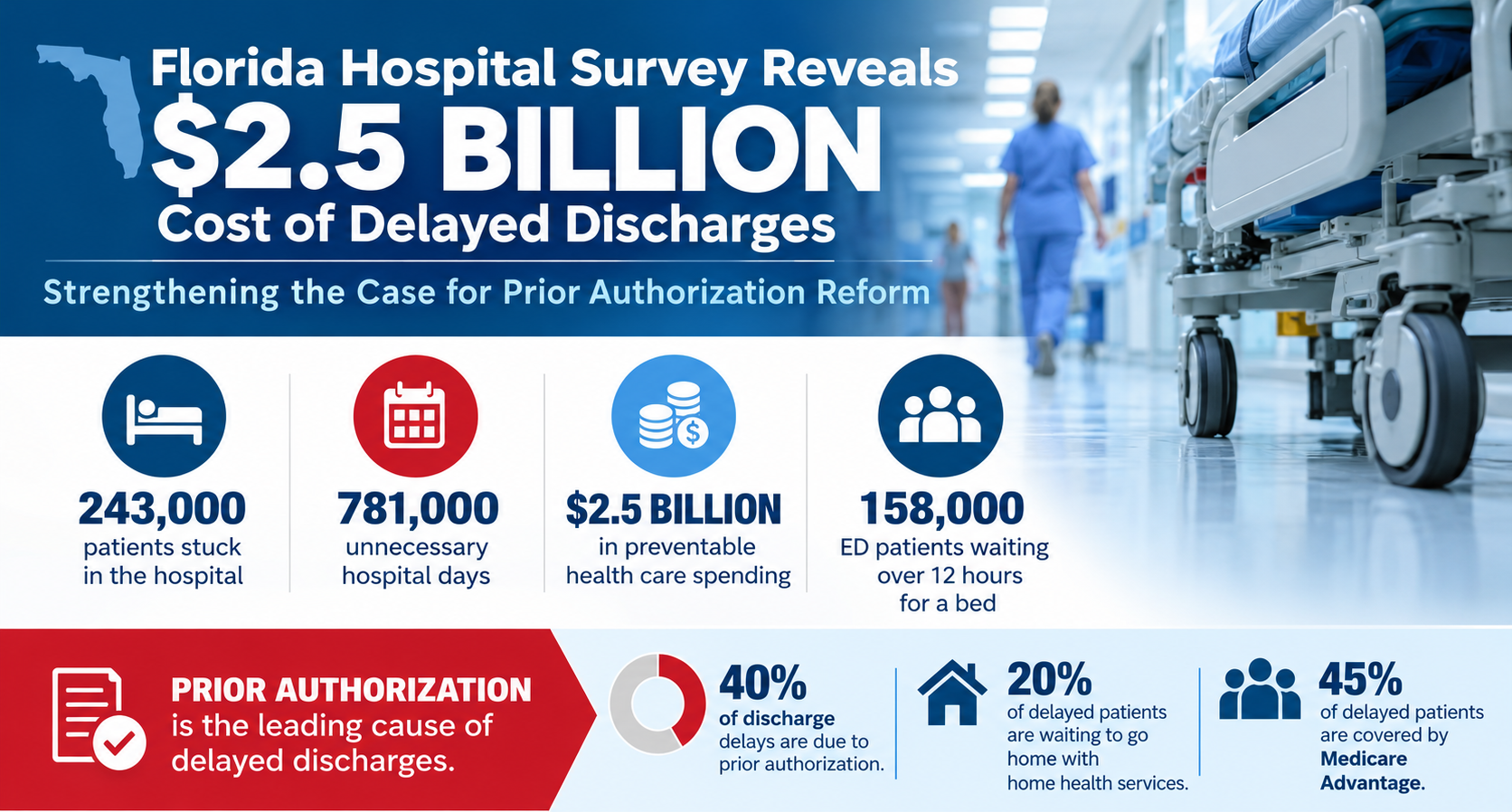
Prior Authorization Is the Leading Cause of Delayed Discharges
FHA's survey, which included 95 hospitals representing 38.2% of Florida's hospital beds, identified waiting for health plan prior authorization as the leading cause of delayed hospital discharges.
The survey identified several contributing factors:
- Prior authorization delays: 40%
- No accepting facility: 26%
- Family, caregiver, or guardianship issues: 18%
- Health plan network adequacy issues: 10%
- Uninsured or homeless patients: 6%
The consequences extend beyond patients waiting to leave the hospital. FHA reported that approximately 158,000 emergency department patients waited more than 12 hours for an available hospital bed during the survey period.
When patients remain hospitalized after being medically cleared for discharge, they may experience interruptions in their recovery while occupying beds needed by other patients requiring acute care.
"An unnecessary hospital day is not simply an administrative inconvenience," said FHA President and Chief Executive Officer Mary Mayhew in an October 5 letter to Florida lawmakers. "The delay keeps a patient in a setting that no longer aligns with their medical needs and prevents the hospital bed from serving another Floridian who needs it."
Home Health Services Are an Important Part of the Discharge Equation
The findings are especially relevant to Florida's home health providers, who play a critical role in helping patients transition safely from hospitals to their homes.
According to FHA's survey, 20% of patients experiencing discharge delays were awaiting discharge home with home health services. Another 41% were awaiting placement in a skilled nursing facility, while 8% required inpatient rehabilitation.
The survey also found that Medicare Advantage beneficiaries accounted for 45% of patients experiencing discharge delays, followed by traditional Medicare beneficiaries at 19%, commercially insured patients at 13%, and Medicaid and Medicaid managed care beneficiaries at 9%.
Among Medicare Advantage patients experiencing discharge delays:
- 52% were awaiting prior authorization
- 54% were awaiting transfer to a skilled nursing facility
- More than 4,000 waited over one week for post-acute care placement
- Patients waited an average of 3.7 additional days after being medically cleared for discharge
For home health agencies, authorization delays can interfere with timely admissions, care coordination, staffing, and the initiation of medically necessary services. Similar administrative challenges arise when agencies encounter delayed authorizations, reauthorizations, reconsiderations, and appeals for patients already receiving care.
These challenges underscore the need for prior authorization policies that facilitate timely access to appropriate services while providing predictable, consistent requirements for providers and health plans.
Florida Hospitals Propose Legislative Reforms
In the October 5 letter to state legislators, FHA outlined proposed reforms intended to reduce unnecessary discharge delays and strengthen health plan accountability.
FHA's anticipated legislation would:
- Eliminate prior authorization requirements for physician-ordered post-acute care at hospital discharge, allowing medically ready patients to transition to appropriate care settings without waiting for health plan approval.
- Establish clear decision-making timelines, requiring health plans to respond to urgent prior authorization requests within 24 hours and nonurgent requests within 72 hours.
- Strengthen peer-to-peer review requirements, ensuring timely reviews of adverse determinations by physicians practicing in the same specialty as the requesting physician.
- Increase transparency and accountability, requiring health plans to report prior authorization metrics annually so regulators can identify patterns of delay and evaluate plan performance.
FHA's survey also recommends holding health plans financially accountable for discharge delays attributable to authorization or network adequacy barriers, along with public reporting of these delays.
The proposed changes are intended to help patients receive medically necessary care sooner, improve hospital capacity, and reduce avoidable spending throughout Florida's health care system.
HCAF Advocacy: Building a Stronger Case for Reform
HCAF has been working to address longstanding concerns among home health agencies regarding inconsistent and burdensome prior authorization requirements, particularly within Florida's Medicaid managed care program.
These concerns include inconsistent documentation requirements, prolonged authorization and reauthorization decisions, administrative obstacles to reconsiderations and appeals, and variation in health plan policies and procedures that complicate patient care and agency operations.
HCAF supports standardized statewide minimum requirements governing prior authorization, reauthorization, reconsiderations, and appeals, along with a collaborative stakeholder process to develop practical solutions for providers and health plans.
The FHA survey offers an important opportunity to strengthen these advocacy efforts by demonstrating that prior authorization delays are not isolated administrative problems but systemwide challenges with measurable consequences for patients, providers, and health care spending.
As preparations for the 2027 Legislative Session continue, HCAF will seek opportunities to partner with FHA and other stakeholders to advance meaningful prior authorization reforms that address the needs of both hospitals and post-acute care providers.
While FHA's immediate legislative proposals focus heavily on hospital discharge processes, HCAF's priorities extend to the broader authorization challenges home health agencies face in securing timely approval and continuity of medically necessary care.
Aligning these efforts could provide a more comprehensive approach to improving transitions of care, reducing unnecessary administrative burdens, strengthening health plan accountability, and ensuring that patients receive appropriate services without avoidable delays.
Federal Reforms Also Under Consideration
FHA is also urging Florida's congressional delegation to support bipartisan federal legislation addressing prior authorization and payment practices under Medicare Advantage.
In a September 24 letter, FHA identified three measures:
- Improving Seniors' Timely Access to Care Act (S. 1816/H.R. 3514): Seeks to modernize and streamline Medicare Advantage prior authorization requirements.
- Medicare Advantage Prompt Pay Act (S. 2879/H.R. 5454): Addresses timely payment for services provided to Medicare Advantage beneficiaries.
- Medicare Advantage Improvement Act (S. 4384/H.R. 8375): Addresses Medicare Advantage practices affecting access to care and plan accountability.
FHA also reported that Florida hospitals had approximately $830.1 million in outstanding Medicare Advantage payments more than 30 days overdue. According to the association, nearly 94% of initially denied claims were eventually paid following appeal, requiring hospitals to expend significant administrative resources to obtain reimbursement for services already provided.
These federal concerns mirror many of the challenges experienced by home health agencies and reinforce the importance of consistent, transparent, and timely authorization and payment practices.
Looking Ahead to the 2027 Legislative Session
With the 2027 Florida Legislative Session scheduled to begin March 2, prior authorization reform presents an important area of potential collaboration among hospitals, home health providers, policymakers, and other health care stakeholders.
FHA's findings quantify the substantial financial and clinical consequences associated with delayed discharges, while HCAF's ongoing work highlights the operational challenges that home health agencies experience throughout the authorization process.
Together, these perspectives can help inform legislative discussions about how to establish clearer standards, reduce unnecessary delays, and improve accountability across Florida's health care delivery system.
HCAF will continue advocating for policies that support timely access to medically necessary home health services, reduce administrative burdens on providers, and strengthen continuity of care for the Floridians they serve.
Editorial Note: The article distinguishes FHA's proposed legislative reforms from HCAF's broader authorization standardization priorities and describes the FHA partnership as an effort HCAF intends to pursue, rather than an established agreement. The survey figures are based on 95 participating hospitals; the article avoids implying that the survey represents a census of all Florida hospitals.