Hurricane Isaias Updates for Florida Home Care Providers

Hurricane Isaias Updates for Florida Home Care Providers

HCAF will use this page to compile Hurricane Isaias-related information affecting home care providers, patients, caregivers, and staff. Providers should review the announcements below, implement their emergency management plans as conditions warrant, and share relevant information with their leadership teams, clinical staff, and emergency preparedness coordinators.
Members are encouraged to visit HCAF's Emergency Preparedness Resources webpage for guidance, checklists, and tools to help protect patients and staff and maintain continuity of care. Please sign in to access these members-only resources.
Because conditions and official instructions can change quickly, continue monitoring the National Hurricane Center, the Agency for Health Care Administration (AHCA) Hurricane Isaias webpage, FloridaDisaster.org, @FLSERT on X, and local emergency management officials.
Latest Update — Friday, October 9, 2026 (8:00 AM ET)
Major Hurricane Isaias Nears Florida Panhandle; Health Care Providers and First Responders Urged to Complete Preparations
As of 8:00 AM ET on Friday, October 9, Hurricane Isaias had strengthened into a Category 3 major hurricane over the north-central Gulf of Mexico.
The storm was located approximately 240 miles south of Pensacola and moving north-northeast at 15 miles per hour. Isaias had maximum sustained winds of 120 miles per hour and a minimum central pressure of 959 millibars.
Isaias is nearing peak intensity, although some additional strengthening remains possible through early Friday afternoon. Increasing wind shear could cause modest weakening before the storm reaches the western Florida Panhandle, but Isaias is still expected to produce life-threatening and destructive conditions.
Forecast guidance continues to indicate landfall in the western Florida Panhandle, with high confidence in that general scenario. Tropical storm-force winds are expected to reach the Panhandle Friday afternoon, followed by hurricane conditions overnight.

Expected impacts include:
- Destructive winds and widespread power outages
- Life-threatening storm surge along portions of the Gulf Coast
- An additional 5 to 10 inches of rainfall, with locally higher totals possible
- Flash flooding, particularly in areas where recent rainfall has already saturated the ground
- Tornadoes across portions of the Florida Panhandle and Big Bend on Friday and Saturday.
A Moderate Risk, or Level 3 of 4, for flash flooding is in effect Friday for Panhandle communities from Jefferson County westward. A Slight Risk, or Level 2 of 4, is forecast Saturday for portions of the central Panhandle and Big Bend as the storm moves away.
Residents, health care providers, and emergency personnel in the affected areas should be prepared to shelter safely later Friday. Preparations and necessary travel should be completed before hazardous winds arrive.
State Mobilizes Health Care and Emergency-Response Resources
Florida has expanded its preparations across health care, public safety, transportation, utilities, and human services. More than 6,000 utility lineworkers and restoration personnel are standing by, approximately 5,000 Florida National Guard members are expected to be mobilized, and nearly 400 Florida State Guard personnel have been deployed for pre-landfall and post-landfall operations.
State response capabilities include high-water vehicles, boats, aircraft, generators, mobile command facilities, emergency communications systems, debris-removal equipment, and urban search-and-rescue teams. Resources are being positioned to support rescues, route clearance, damage assessments, supply distribution, security operations, and infrastructure recovery.
The Florida Department of Law Enforcement is coordinating law enforcement assets, communications equipment, mobile command posts, aviation resources, and fuel support along the Interstate 10 corridor. The Florida Highway Patrol is monitoring evacuation routes, escorting fuel and utility vehicles, and staging members of its Quick Response Force.
The Florida Fish and Wildlife Conservation Commission has prepared airboats, shallow-draft vessels, all-terrain vehicles, high-water vehicles, aircraft, and specialized officers for water rescues, reconnaissance, and post-storm damage assessments.
Health Care and Human Services Preparations
The Florida Agency for Health Care Administration (AHCA) has activated the Emergency Patient Look-Up System (E-PLUS), including emergency census, patient-search, missing-persons, and medication-search capabilities. AHCA has also opened a Health Facility Reporting System event for facilities in the 27 counties covered by the state’s expanded emergency declaration and has conducted outreach to hospitals and residential health care facilities.
Early prescription refill edits remain suspended for maintenance medications provided to Medicaid recipients in the 25 counties included in the original state of emergency. The temporary flexibility applies to fee-for-service and managed care providers but does not apply to controlled substances.
The Florida Department of Health has moved warehouse operations to a 24-hour schedule and deployed an AmbuBus to support potential patient transportation. The department is also coordinating with county emergency management officials on special needs shelters in Escambia, Santa Rosa, Walton, Okaloosa, Bay, Washington, and Holmes counties. Some county health departments have announced temporary closures.
The Agency for Persons with Disabilities is contacting clients and providers in potentially affected areas, monitoring state-operated facilities, and collecting information about operational conditions and unmet needs. The Florida Department of Children and Families is coordinating supplies, shelter support, generator needs, and outreach to foster families, group homes, protective-services clients, and licensed providers.
The Florida Department of Elder Affairs and local aging organizations are contacting older adults in affected communities, coordinating with service providers, and assessing needs before landfall.
Actions for Home Care and Health Care Providers
HCAF urges providers in the Florida Panhandle and Big Bend to complete final preparations immediately. Agencies should:
- Activate their emergency management and continuity-of-operations procedures
- Confirm the location, condition, and evacuation plans of patients with the most urgent needs
- Prioritize patients who depend on electricity, oxygen, ventilators, refrigeration, medication, medical equipment, or uninterrupted services
- Verify emergency contact information for patients, caregivers, employees, vendors, and community partners
- Confirm staffing assignments, backup coverage, transportation arrangements, and employee communication procedures
- Ensure medications, clinical supplies, fuel, batteries, chargers, and other essential resources are available
- Coordinate with local emergency management officials, special needs shelters, hospitals, pharmacies, managed care plans, and equipment suppliers
- Complete required reporting through the Health Facility Reporting System and other applicable state systems
- Prepare for disruptions involving electricity, cellular service, internet access, transportation, staffing, and supply deliveries
- Establish procedures for post-storm patient checks, employee accountability, damage assessments, and reporting unmet needs
Providers should not place staff at unnecessary risk once tropical storm-force winds begin. Agencies should follow evacuation orders, curfews, road closures, and instructions issued by state and local officials.
Transportation and Access
The Florida Department of Transportation has nearly 900 personnel conducting preparations, with approximately 260 pieces of heavy equipment, 1,000 generators, and 100 pumps staged for deployment. Crews are inspecting drainage systems, monitoring flood-prone roads and bridges, and positioning bridge inspectors for post-storm assessments.
Tolls have been suspended on the Mid-Bay Bridge and Spence Parkway in Okaloosa County and the Garcon Point Bridge in Santa Rosa County to support evacuations. Providers should monitor FL511.com or the Florida 511 mobile application for road closures, bridge conditions, and detours.
Continue Monitoring Official Information
Forecasts and local instructions can change quickly. Providers should continue monitoring the National Hurricane Center, FloridaDisaster.org, @FLSERT on X, and county emergency management officials.
Members can also visit HCAF's Emergency Preparedness Resources webpage for checklists, guidance, and tools to help protect patients and staff and maintain continuity of care. Please sign in to access these members-only resources.
The next state briefing packet is expected at 11:00 AM Friday. HCAF will continue updating its Hurricane Isaias information page as additional provider guidance and emergency information become available.
Thursday, October 8, 2026 (4:00 PM ET)
Thursday, October 8, 2026 (11:00 AM ET)
Hurricane Isaias Strengthens: Home Health Providers Urged to Complete Preparations Today
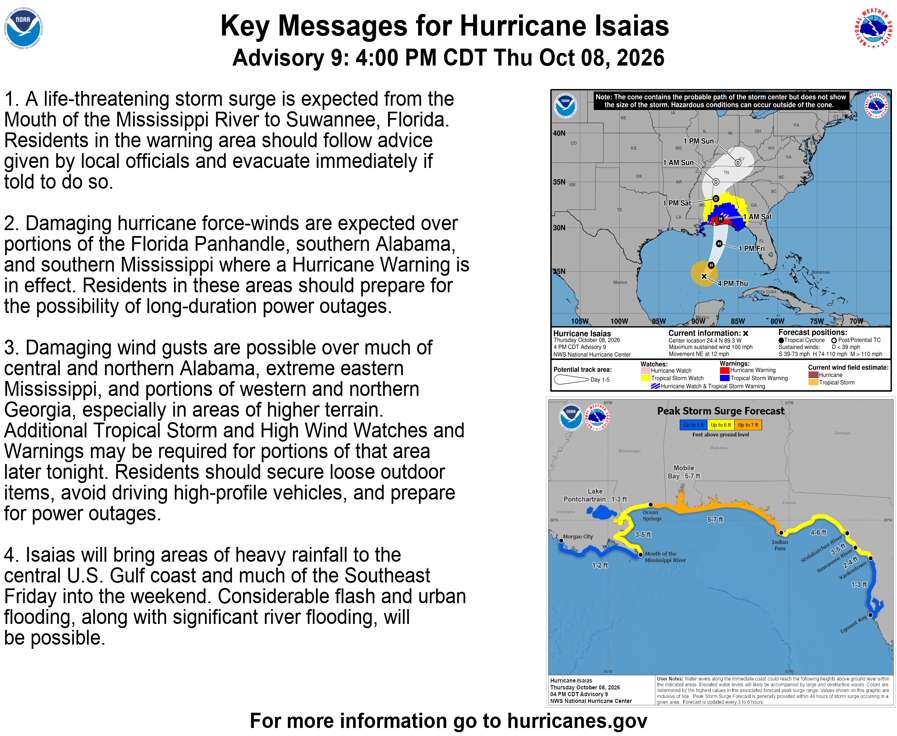
According to the supplied 8:00 AM ET briefing, Hurricane Isaias is a Category 1 hurricane with maximum sustained winds of 80 mph, moving east-northeast at 9 mph. Additional strengthening is expected, with the first hurricane of the 2026 Atlantic hurricane season forecast to reach Category 2 strength before approaching the far western Florida Panhandle late Friday night or early Saturday morning.
Although the precise track and landfall intensity remain uncertain, dangerous conditions could extend well beyond the landfall location. Potential impacts include:
- Strong winds and storm surge across portions of North Florida
- Heavy rainfall of 5-10 inches, with isolated totals up to 15 inches, potentially worsening flooding in areas already saturated by recent rainfall
- Flash flooding, with a Moderate Risk identified for Panhandle locations west of the Apalachicola River
- Tornadoes, including potentially strong tornadoes, across portions of the Panhandle and Big Bend on Friday and Saturday
HCAF encourages providers to review and implement their emergency management plans as conditions warrant. Confirm patient and staff communication procedures, prioritize outreach to patients who rely on electricity or uninterrupted services, review evacuation and shelter arrangements, and coordinate staffing and essential supplies.
Please share this announcement with your leadership team, clinical staff, and emergency preparedness coordinator.

Wednesday, October 7, 2026
Florida Medicaid Lifts Early Prescription Refill Edits in Counties Affected by Tropical Storm Isaias
The Florida Agency for Health Care Administration (AHCA) has temporarily lifted early prescription refill edits for Medicaid recipients in the 25 counties included in the state of emergency for Tropical Storm Isaias.
The flexibility took effect October 7, 2026, and applies to both fee-for-service and managed care providers. It is intended to help Medicaid recipients maintain access to critical maintenance medications while preparing for and responding to the storm.
The temporary policy applies to all maintenance medications for Medicaid recipients in the affected counties. It does not apply to controlled substances.
The flexibility will remain in effect until 60 days after the expiration of Governor Ron DeSantis’ executive order unless AHCA extends it.
Providers should work with affected patients, pharmacies, and health plans to help ensure that necessary medications remain available throughout the emergency.
Additional Medicaid updates related to Tropical Storm Isaias will be posted on AHCA's website here.
For questions, email FLMedicaidManagedCare@ahca.myflorida.com. To report a complaint or issue, visit the Florida Medicaid complaints webpage or call (877) 254-1055.
October 6, 2026
Tropical Storm Isaias Forms; State of Emergency Remains in Effect for 25 Florida Counties
Governor Ron DeSantis issued Executive Order 26-202 on October 6, 2026, declaring a state of emergency in 25 Florida counties ahead of potential impacts from Tropical Depression Nine. All counties in Florida Health Care Regions 1 and 2 are included:
- Region 1: Escambia, Okaloosa, Santa Rosa, and Walton
- Region 2: Bay, Calhoun, Franklin, Gadsden, Gulf, Holmes, Jackson, Jefferson, Leon, Liberty, Madison, Taylor, Wakulla, and Washington
The system was still Tropical Depression Nine when the executive order was issued but strengthened into Tropical Storm Isaias overnight. As of 4:00 AM CT on October 7, the storm was about 580 miles southwest of the mouth of the Mississippi River, with maximum sustained winds near 40 miles per hour. The National Hurricane Center forecasts rapid strengthening and expects Isaias to become a hurricane before approaching the northern Gulf Coast on Friday. Florida Panhandle residents should closely monitor the forecast, as the storm’s track and impacts remain subject to change.
The executive order allows the Florida Division of Emergency Management to stage resources and coordinate the state’s response. Potential threats include damaging winds, heavy rainfall, storm surge, tornadoes, flash flooding, and river flooding.
The National Hurricane Center forecasts rainfall totals of 3 to 6 inches across the northern Gulf Coast beginning Friday and continuing through the weekend, with localized totals of up to 10 inches possible. Recent rainfall has already saturated soils and elevated water levels across portions of North Florida, increasing the risk of flooding, transportation problems, power outages, and interruptions to essential services.
HCAF encourages home health providers serving these regions to take preparedness steps now:
- Review your agency’s emergency management plan and ensure staff understand their responsibilities.
- Confirm contact information and communication plans for patients, caregivers, employees, vendors, and community partners.
- Prioritize outreach to patients who depend on electricity, oxygen, medical equipment, medications, or uninterrupted care.
- Review evacuation and shelter arrangements, staffing coverage, transportation needs, and plans for maintaining essential services.
- Confirm that staff and patients have adequate emergency supplies and know how to receive agency updates.
- Coordinate with local emergency management officials and monitor official alerts, watches, warnings, and evacuation instructions.
- Prepare for possible disruptions involving electricity, communications, transportation, staffing, and supply deliveries.